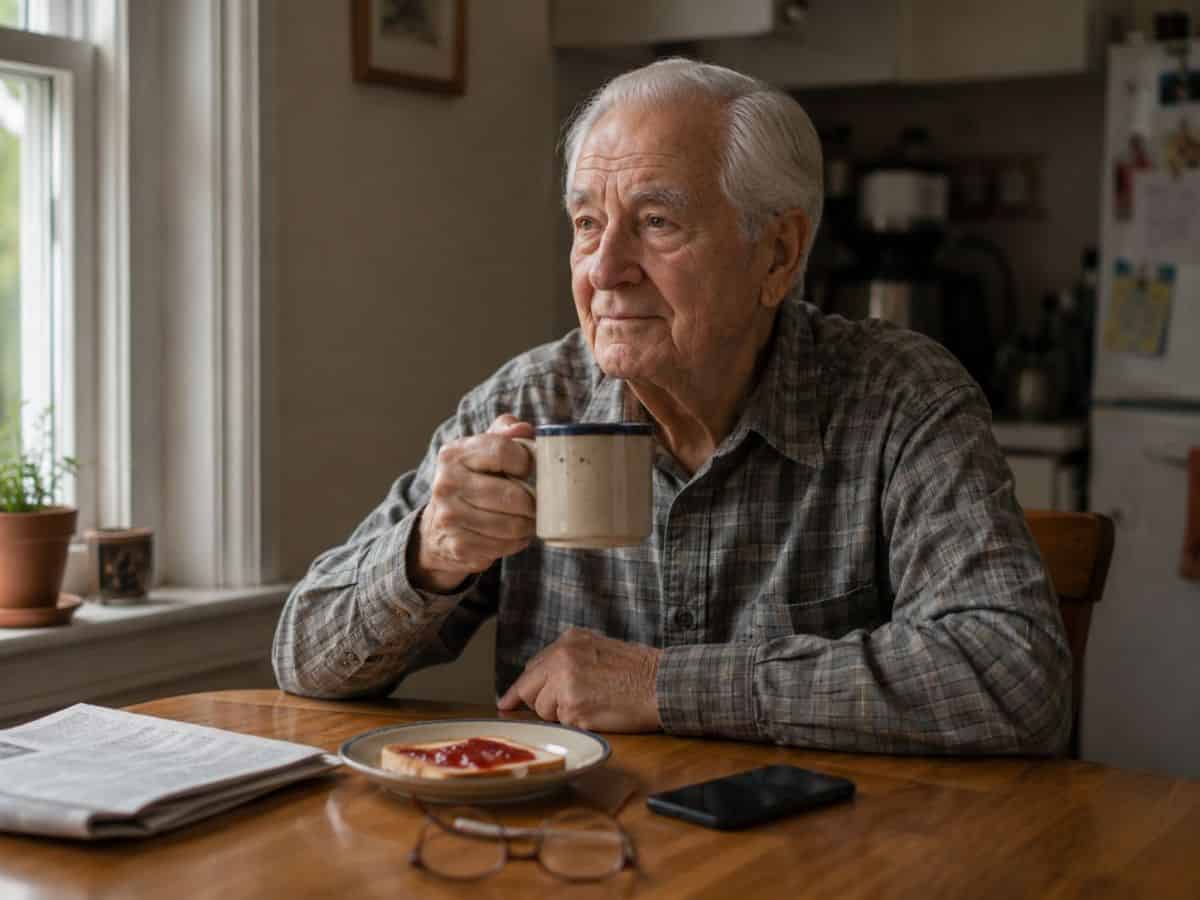
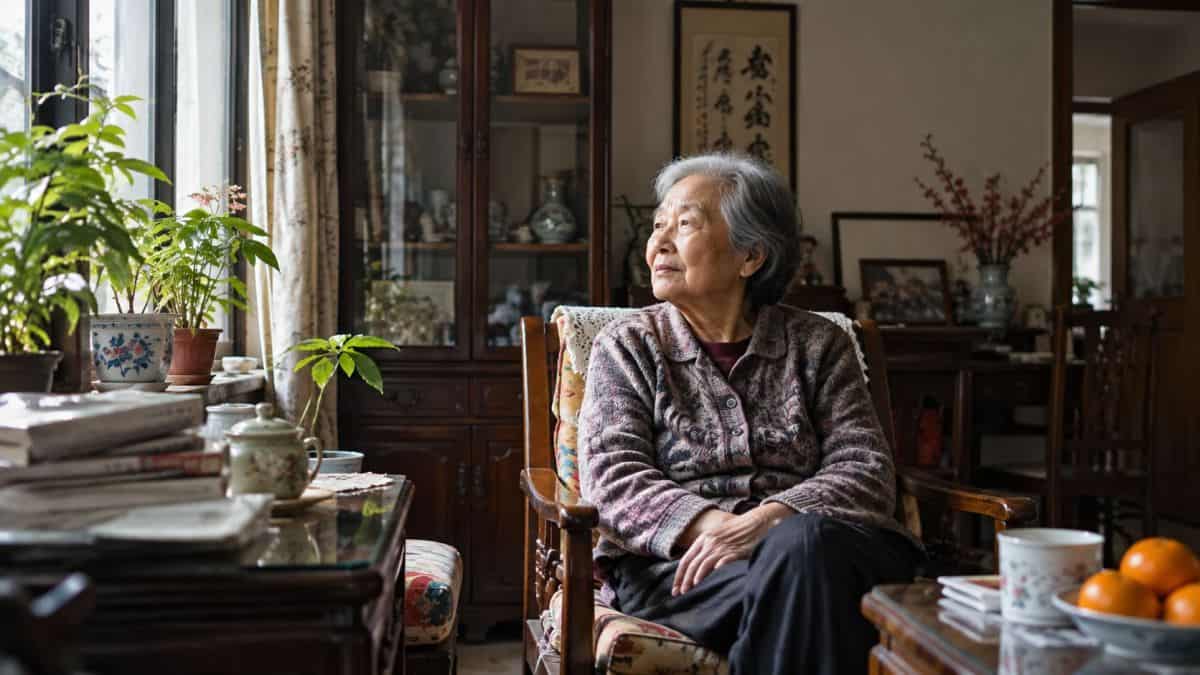
Your mother still lives in the home she has known for years. You live somewhere else. Maybe another city. Maybe another region, quite possibly another country. Usually, she answers your message sometime in the morning. Today, she hasn’t. Nothing has happened, as far as you know. She might be out shopping, talking to a neighbour, working in the garden, taking a nap or simply ignoring her phone.
And still, somewhere in the background, the question appears:
Is everything okay?
For a growing number of European families, this is becoming a familiar part of having an older parent who lives independently.
It does not necessarily mean providing daily hands-on care. It does not necessarily mean that the parent is frail or needs to move somewhere else. Often, it simply means trying to respect someone’s independence while accepting that, from a distance, you cannot always tell the difference between an ordinary quiet day and one in which something has changed.
And Europe is moving steadily toward having more families in exactly this situation.
The population is getting older. One-person households have become more common. Millions of relatives provide unpaid care or support, often while also working. Families are increasingly geographically dispersed. At the same time, digital technology is becoming part of everyday life for many older Europeans — although the digital divide has certainly not disappeared.
Put those changes together and we arrive at much the same question we already talked about: How can families stay aware without turning independence into surveillance?Here is what the European data tells us.
1. Europe is already an older continent
Europe’s demographic shift is not something waiting for us in the future. It is already here.
On 1 January 2025, 99 million people in the European Union were aged 65 or older. That was 22% of the entire EU population — more than one person in five. Another 6% of the population was already aged 80 or older.
Twenty years earlier, people aged 65+ made up 17% of the EU population. The EU’s median age has meanwhile risen from 39.6 years in 2005 to 44.9 years in 2025.
There are large differences between countries. Italy had the highest median age in the EU in 2025 at 49.1 years, followed by Bulgaria and Portugal at 47.3 and Greece at 47.2. Ireland, Luxembourg and Malta remained considerably younger.
But the direction is broadly the same. More Europeans are reaching older age, and many will spend a significant part of those additional years living in ordinary homes and communities rather than in residential care.
That also means more people will eventually need some form of help. The European Commission projects that the number of people in the EU needing long-term care could rise from 30.8 million in 2019 to 38.1 million by 2050.
This is not simply a question for governments or health-care systems.
It changes what family life looks like too.
2. Living alone has become a normal part of later life
Europe’s households are getting smaller.
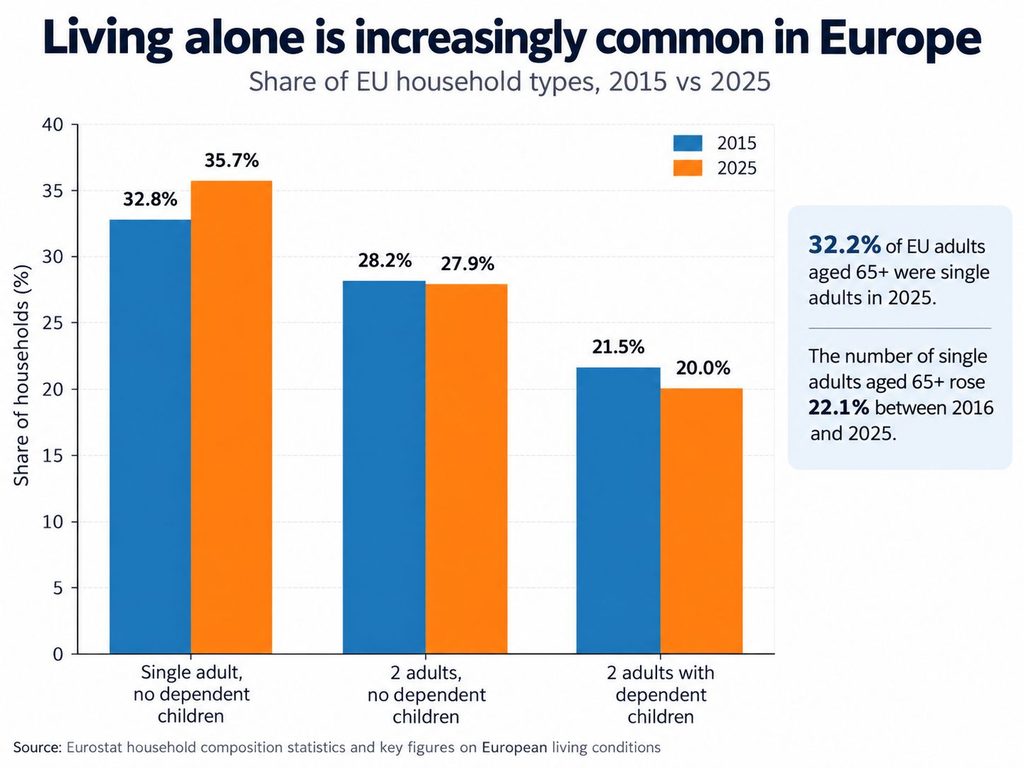
In 2025, the EU had about 203 million households. More than 76 million consisted of a single adult without children. Single-adult households were the fastest-growing major household type between 2016 and 2025, increasing by about 19%.
Age makes the pattern even more noticeable.
Eurostat’s 2025 household data classified 32.2% of adults aged 65 or older as single adults. The number of single adults in this age group had increased by 22.1% since 2016.
And there is an important gender dimension. Older women have historically been considerably more likely than older men to live alone, partly because women tend to live longer. Eurostat’s earlier EU-wide analysis, for example, found that around 40% of women aged 65+ lived alone compared with 22% of men.
Living alone is not the same thing as being lonely. And it is definitely not the same thing as being incapable.
Someone can live alone at 78 and have a very full life: friends nearby, family visits, a dog that needs walking, neighbours they have known for decades, weekly activities, a local café, their own routines and a home they know down to the last drawer. Another person can live with relatives and still feel isolated.
Eurostat’s household statistics also cover people living in private households, not people living in institutions or other collective households, so they should not be interpreted as a complete picture of every older European.
The practical issue is much narrower. When one person lives alone, there may simply be nobody else in the house who notices that today’s routine is different from yesterday’s. That is not a failure of independent living. It is one of its consequences.
3. Staying at home does not mean doing everything alone
There is sometimes an odd assumption hidden inside conversations about aging: either an older person is completely independent, or they are receiving care. Real life is rarely that tidy.
Someone may live alone and still have a cleaner once a week. A daughter may organise appointments from another city. A neighbour might pick up groceries. A nurse may visit periodically. A son may handle online paperwork. Another relative may call every evening.
Independence can include support.
European policy increasingly reflects that idea. The European Care Strategy calls for a broader mix of long-term-care options, including home care, community-based services and residential care, with the goal of helping people retain autonomy and dignity. It also explicitly includes digital solutions and support for informal carers.
The latest data shows why this mix matters.
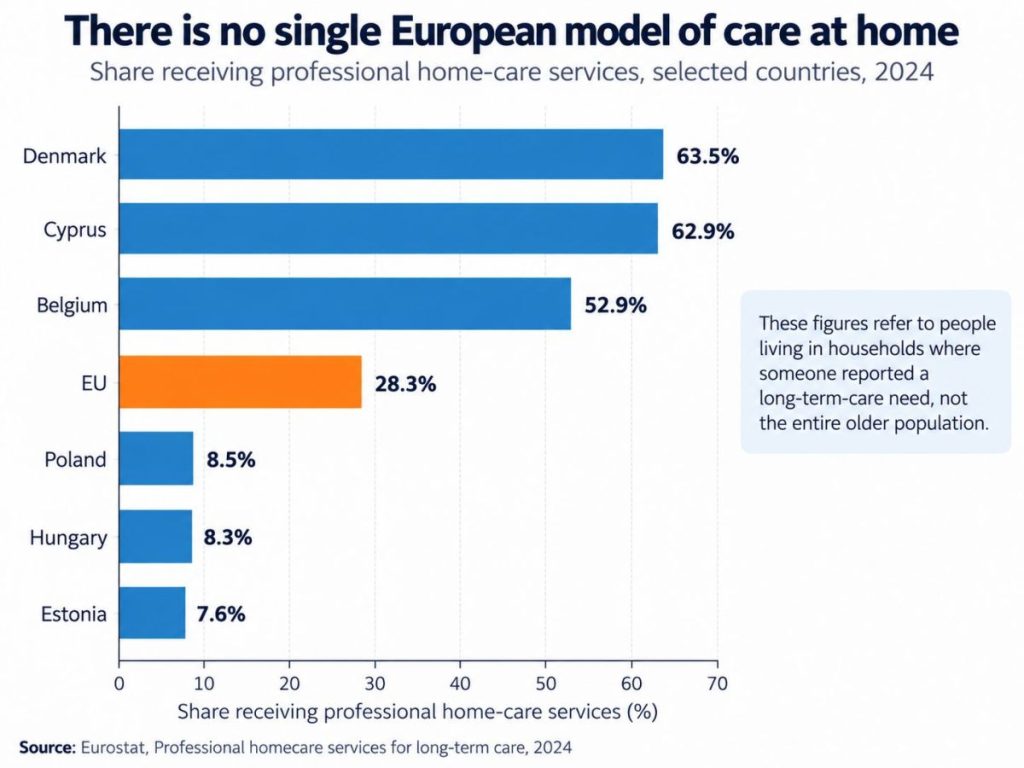
In 2024, 8.5% of people in the EU lived in a household where at least one person needed long-term care because of health problems. Among people in those households, 28.3% received professional home-care services.
That figure varies enormously from one country to another. Professional home care reached more than half of people in households with long-term-care needs in Denmark, Cyprus and Belgium, while the reported shares were below 10% in Estonia, Hungary and Poland.
That does not mean everyone without professional home care is being left without help. Some receive assistance from relatives, friends or other services, and care needs themselves vary. What it does show is that there is no single European model of aging at home. A family in Denmark, Spain, Romania, France or Poland may be navigating a very different combination of public services, paid help and family involvement.
The common thread is that living independently increasingly sits inside a network of support rather than outside one.
4. Families are already providing an enormous amount of that support
Much of Europe’s care system is almost invisible because it happens inside ordinary family life.
- A parent needs groceries.
- Someone drives them to an appointment.
- A prescription needs renewing.
- A daughter phones the doctor.
- A son sorts out a utility bill online.
- Someone checks whether Dad remembered that appointment on Thursday.
At what point does that become “caregiving”? Often, families do not know themselves.
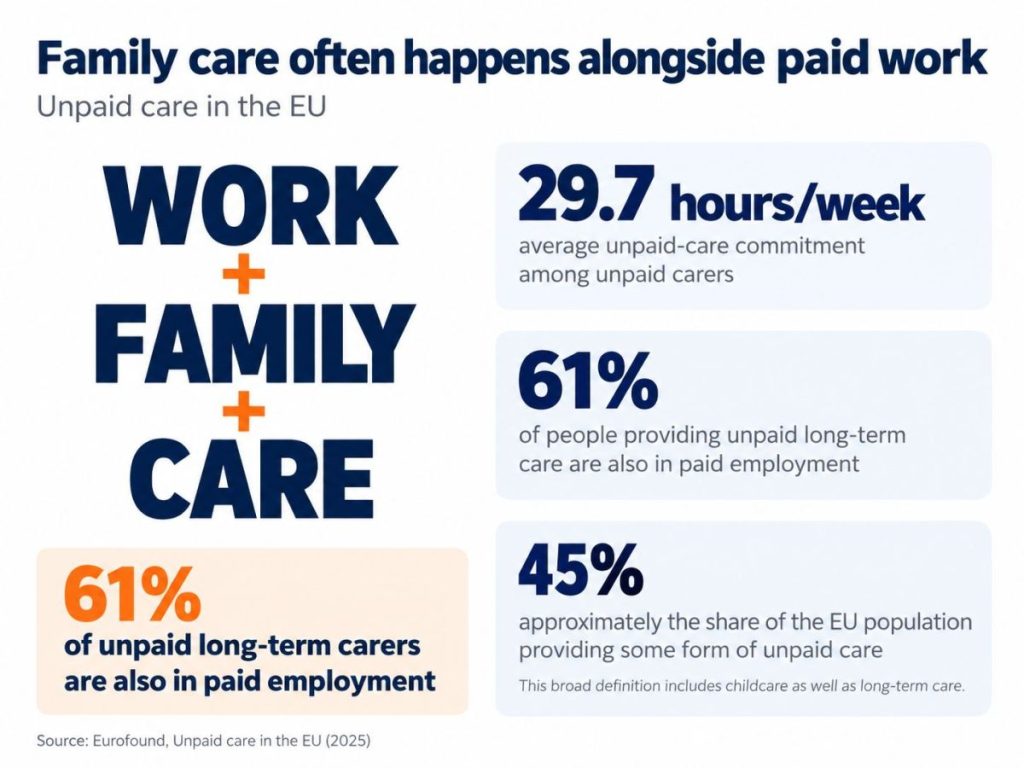
Eurofound’s 2025 report on unpaid care estimated that around 45% of the EU population provides some form of unpaid care. That definition is broad — importantly, it includes childcare as well as care and support related to illness, disability or old age — so it should not be read as saying that almost half of Europeans care for an older adult.
But the report gives us a useful picture of just how deeply unpaid care runs through European life.
Across all unpaid carers, the average commitment was 29.7 hours per week. And among people providing unpaid long-term care specifically, 61% were also in paid employment. Women were more likely to provide unpaid care and particularly likely to provide intensive care or juggle several care roles at once.
Eurofound also points to something important for the future: smaller families, lower fertility, greater geographical dispersion and changing family structures are reducing the pool of relatives traditionally available to provide care.
So, the question is not simply whether European families will continue caring for older relatives. They almost certainly will. The harder question is how they will do it when there are fewer people available, more of them are working, and family members increasingly live somewhere else.
5. In Europe, distance can mean another country
Distance has a slightly different character in Europe than it does in the United States, for example. Countries are smaller. A flight between two capitals might take only a couple of hours. High-speed trains and inexpensive air travel make borders feel surprisingly close. But close enough for a weekend visit is not the same thing as close enough to knock on someone’s door at 10:30 on a Tuesday morning.
On 1 January 2025, about 14 million EU citizens were living in an EU country other than their country of citizenship.
In total, around 45 million EU residents had citizenship different from the country where they lived.
Those are migration statistics, not caregiving statistics. They do not tell us how many of those people have an older parent living somewhere else. But they help explain why we should not automatically imagine European families as living in the same town.
Eurofound specifically identifies increasing geographical dispersion as one of the changes weakening traditional family support networks. For some families, caring therefore happens partly through physical visits and partly through phones and laptops.
- You call.
- You send messages.
- You arrange appointments.
- You order something online.
- You speak to a sibling who lives closer.
- You remind your parent about something they mentioned yesterday.
And sometimes you start paying attention to very small signals.
- Mom hasn’t answered yet.
- Dad normally sends a message in the morning.
- She hasn’t used her phone much today.
- He said he wasn’t feeling quite right last night.
- None of those things necessarily means something is wrong.
But when you live far enough away, ordinary communication starts carrying information that proximity used to provide automatically.
6. Digital life is becoming part of aging — but not equally
There is another important change happening at the same time. Older Europeans are becoming increasingly connected digitally.
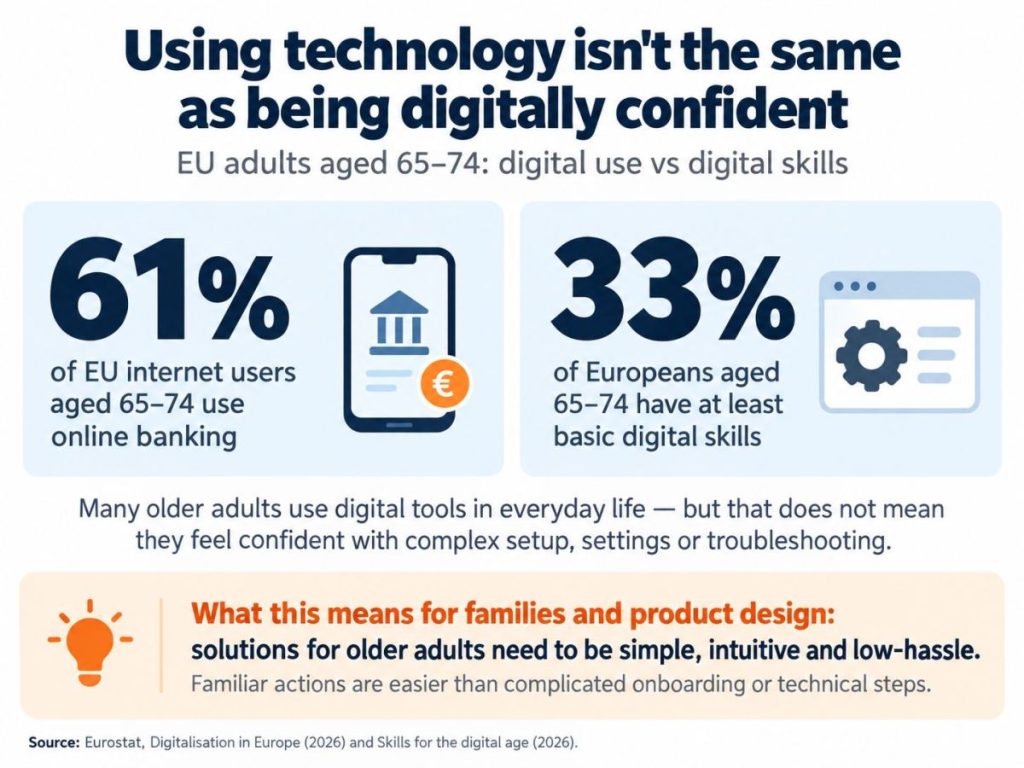
In 2025, 94% of people in the EU aged within Eurostat’s standard internet-use survey range had used the internet during the previous three months. Among internet users aged 65–74, 61% used online banking, and more than half shopped online.
That matters because it challenges the idea that technology for older adults always needs to begin with a special device designed specifically for “seniors.” For many people in their late sixties and early seventies, digital technology is already part of ordinary life.
But there is another number we should put beside that one. In 2025, only 33% of Europeans aged 65–74 had at least basic digital skills, compared with roughly three quarters of people aged 16–34.
These findings are not contradictory. Someone can comfortably use WhatsApp, check the weather and make a video call while still finding unfamiliar settings, complicated onboarding or account permissions confusing.
And there is another limitation worth noticing: Eurostat’s main household ICT survey covers people only up to age 74. We therefore have much better comparable digital data for a 68-year-old than for an 82-year-old.
That matters for anyone designing technology for aging populations. The opportunity is real. So is the responsibility to keep things simple.
7. The UK shows much the same pattern
The United Kingdom is no longer part of the European Union, so its statistics should not simply be mixed into EU-27 totals. But looked at separately, the underlying family pattern is remarkably familiar.
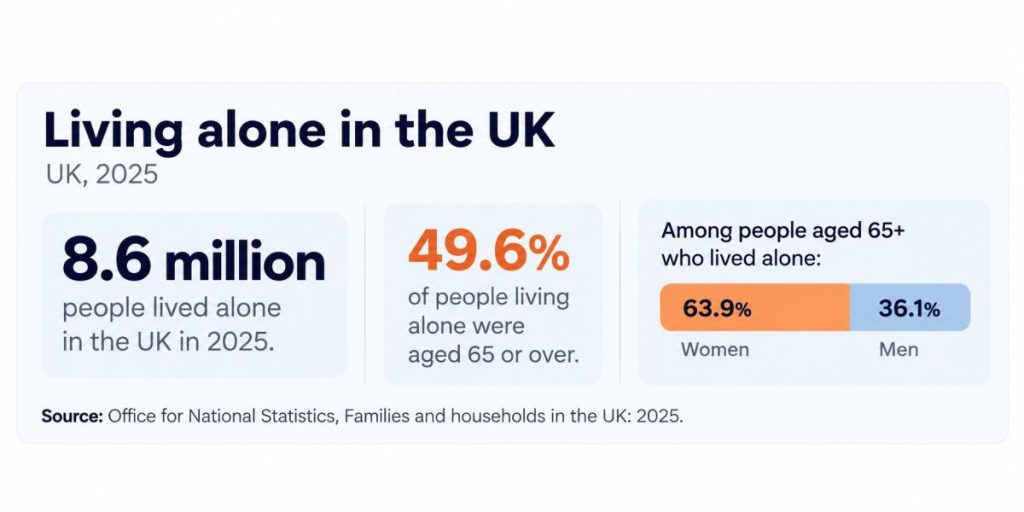
According to the Office for National Statistics, 8.4 million people lived alone in the UK in 2024, up from 7.6 million ten years earlier.
More strikingly, 4.3 million of them were aged 65 or older. People aged 65+ accounted for 51.1% of everybody living alone in the UK, compared with 45.5% in 2014. Among people aged 65+ living in households, 40.9% of women and 27.0% of men lived alone.
Family care is substantial there too. The 2021 Census counted approximately 5 million people providing unpaid care in England and Wales alone. Around 1.5 million reported providing 50 hours or more of unpaid care each week.
Those figures cannot be compared directly with Eurofound’s EU estimates — the definitions, years and geographic coverage are different. But they tell a similar story. An aging population does not simply create more older people.
It creates more relationships in which one adult is trying to maintain their own life while also keeping an eye on somebody else’s.
8. Safety is useful only if independence survives it
Technology can make some of this easier. It can also make it worse. Once a family becomes worried, the natural instinct is to want more information.
- A camera tells you more than a simple activity signal.
- GPS gives you more information than knowing someone has used their phone.
- Continuous monitoring provides more information than an occasional check-in.
But more information is not automatically better care.
A 2025 peer-reviewed study examined attitudes toward smart-home health technology through interviews with older adults and formal and informal caregivers in German-speaking Switzerland. Participants raised concerns not only about what information technologies collected and who might use it, but also about how sensors and other monitoring devices changed the feeling of privacy inside the home.
It was a qualitative study involving a relatively small group, so it should not be treated as a survey of all European older adults. But the tension it describes is worth paying attention to. The home is not simply the place where an older person happens to receive care. It is their private space.
And an older parent does not stop being an autonomous adult because their children have started worrying about them. That creates a useful design question.
Instead of asking: How much can we monitor?
Perhaps the better question is: What is the smallest amount of information that would actually help?
The real problem may still be uncertainty
No single statistic in this article proves that monitoring technology will make an older person safer. And Europe’s care systems are far too different to reduce the continent to one simple model. But several trends are clearly moving together.
The EU now has 99 million people aged 65+.
- One-person households have grown rapidly, including among older adults.
- Demand for long-term care is expected to increase.
- Families already provide an enormous amount of unpaid support.
- Geographic mobility means relatives may live in another city or another country.
- And digital technology is increasingly part of older people’s daily lives, even though significant age-related differences in digital skills remain.
Together, those changes create a particular kind of family problem. Our parents may be perfectly capable of living independently. Most days, there is no reason for us to know exactly what they are doing. And that is the point.
- Mom should be able to spend the afternoon reading without generating an alert.
- Dad should be able to go for coffee without anybody needing his location.
- Someone should be able to sleep late, walk the dog, garden, visit a friend or simply leave their phone alone for a while without being treated like a person who needs supervision.
What families often need is not constant information. They need enough information to notice when something looks different from normal. That is the space in which tools like Parents are OK are intended to operate.
Not as a replacement for calling your parents. Not as medical monitoring. Not as an emergency response service. And not as a way of watching someone throughout their day.
The idea is much smaller: use a limited signal — such as whether the person’s phone has shown normal activity within a time period that fits their own routine, including their usual sleep or rest hours — to help a family decide when an actual human check-in may be worthwhile. Because independence and caring are not opposites. The challenge is finding ways to support one without quietly taking away the other.
Where Parents are OK fits
This is also the kind of situation we had in mind when we created Parents are OK.
The app is not designed to tell families everything an older parent is doing. It does not use GPS, cameras or microphones. Instead, it looks for simple signs of normal phone activity and lets families set a time window that makes sense for that person’s routine, including their usual sleep or rest hours.
The idea is not to replace calls, visits, neighbours, home-care services or family involvement. It is simply to offer one more quiet signal in the background — something that can help you notice when a normal pattern changes and decide whether it may be worth checking in.
For families living in different homes, cities or countries, sometimes that small amount of information is enough.
And me?
The more I read about aging in different countries, the more I come back to the same tension: we want our parents to remain independent, but we also want to know they are okay. Those two things do not have to contradict each other.
For me, the answer is not knowing more and more about someone’s day. It is finding the smallest amount of information that helps us stay connected without turning care into supervision and control.
And Europe makes that question especially interesting. Families live across cities and borders, care systems differ enormously from one country to another, and yet the emotional problem often sounds remarkably similar.
How does your family find that balance between staying aware and giving an older parent the space to live independently?
Talk soon,
Ioana
Research referenced:
Tian et al. — Monitored and Cared for at Home? Privacy Concerns When Using Smart Home Health Technologies to Care for Older Persons
View research
Eurostat — Demography of Europe: 2026 edition
View source European Commission
Eurostat — Household composition statistics
View source European Commission
Eurostat — Key figures on European living conditions: 2026 edition
View source European Commission
Eurostat — Professional homecare services for long-term care, 2024
View source European Commission
Eurofound — Unpaid care in the EU
View source Eurofound
European Commission — Long-term care
View source Employment, Social Affairs and Inclusion
European Commission — A European Care Strategy for caregivers and care receivers
View source Employment, Social Affairs and Inclusion
Eurostat — Digitalisation in Europe: 2026 edition
View source European Commission
Eurostat — Skills for the digital age
View source European Commission
Office for National Statistics — Families and households in the UK: 2025
View source Office for National Statistics
Office for National Statistics — Unpaid care, England and Wales: Census 2021
View source Office for National Statistics

My guiding question every day is: ”How can I make this better?” I have a creative mind, an eye for all things beautiful, and a drive to bring people together. With a background in non-formal education, psychology, entrepreneurship, and interior design, I believe there is always a new opportunity around the corner. Life is interesting. Enjoy and make the most of it!