For generations, growing old in much of East Asia usually came with an assumption: family would be there.
Parents cared for children. Adult children, in turn, were expected to care for their parents. Several generations might live together, or at least close enough for support to be part of everyday life. That expectation has not disappeared. But the families underneath it are changing.
People are living longer. Birth rates have fallen dramatically. Families are smaller. Adult children are more likely to live and work away from their parents. Women — historically responsible for much of the hands-on care — have their own jobs. And there are simply fewer adult children available to share the responsibility.
At the same time, older adults increasingly want something that is familiar elsewhere in the world: to remain in their own homes for as long as possible.
East Asia is therefore becoming one of the clearest places to see what happens when longer lives, very low fertility and changing family structures meet.
The demographic shift is happening extraordinarily quickly
Population ageing is not unique to East Asia, but its speed is.
Across Asia and the Pacific, 516 million people were already aged 65 or older in 2025, representing 10.8% of the region’s population. By 2050, ESCAP projects that share to reach 19.4%.
Some East Asian societies are already far beyond that point.
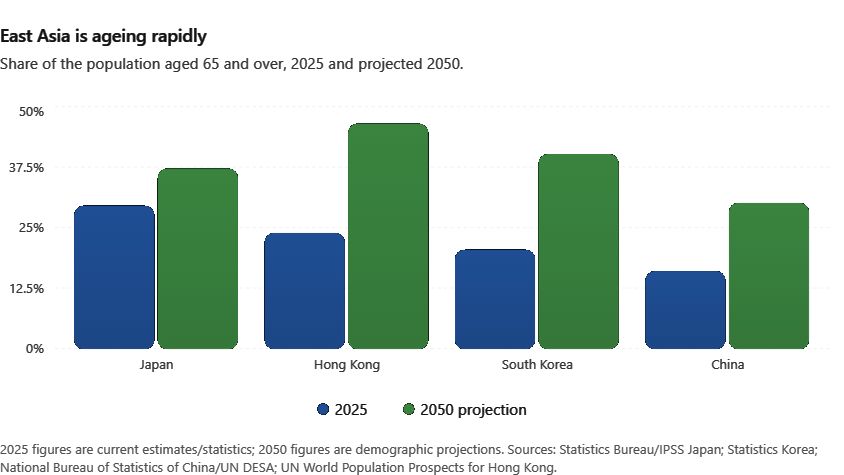
Japan
In 2025, Japan had about 36.2 million people aged 65 or older.
They represented 29.4% of the population — almost three people in every ten.
Japan has lived with population ageing longer than its neighbors, which makes it something of a preview of where other countries in the region may be heading.
South Korea
South Korea crossed another symbolic threshold in 2025. People aged 65 and over represented 20.3% of the population, meaning the country had entered what demographers commonly call a super-aged society.
The transformation is far from finished. Korean official projections indicate that the 65+ population could exceed 30% in 2036 and 40% in 2050.
China
China’s percentages are lower, but its enormous population changes the scale of the challenge.
At the end of 2025, China had approximately: 323 million people aged 60 or older, and 224 million aged 65 or older. That means 15.9% of China’s population was already 65+.
Meanwhile, the country’s population is shrinking. China recorded 7.92 million births and 11.31 million deaths in 2025.
There are therefore more older people needing some form of support at precisely the time when younger generations are becoming smaller.
Hong Kong
Hong Kong is further along the same path.
Official projections estimate that, excluding foreign domestic helpers, the number of people aged 65+ could rise from 1.45 million in 2021 to 2.74 million by 2046.
By then, older people would represent about 36% of the population. More than one person in three.
The numbers differ from country to country, but the direction is remarkably consistent:
more older adults, living longer, supported by smaller younger generations.
A family-care model built for larger families is being tested by smaller ones
Numbers alone don’t explain why ageing in East Asia is particularly interesting. Family structure does.
Ideas connected to filial responsibility have historically played an important role across China, Korea and Japan, although traditions and actual family arrangements vary considerably between and within these societies.
Care for ageing parents has often been understood not simply as a service someone provides, but as part of the relationship between generations.
That model becomes much more difficult when there is only one adult child.
China’s decades-long demographic transition provides an obvious example. A smaller generation of adult children is increasingly responsible not only for their own children but potentially for multiple ageing parents and grandparents. But the change extends far beyond China.
Marriage is happening later or not at all. Fertility is extremely low across much of the region. Younger adults migrate toward major employment centers. Women have careers and cannot automatically become full-time caregivers.
The result isn’t necessarily that families care less. It’s that family care has to operate under completely different demographic conditions.
More older people are living alone
One of the most visible consequences is a gradual change in household structure. ESCAP‘s latest comparable data show substantial differences across Asia, but Japan and South Korea are among the countries in the region where living alone in older age has become particularly significant.
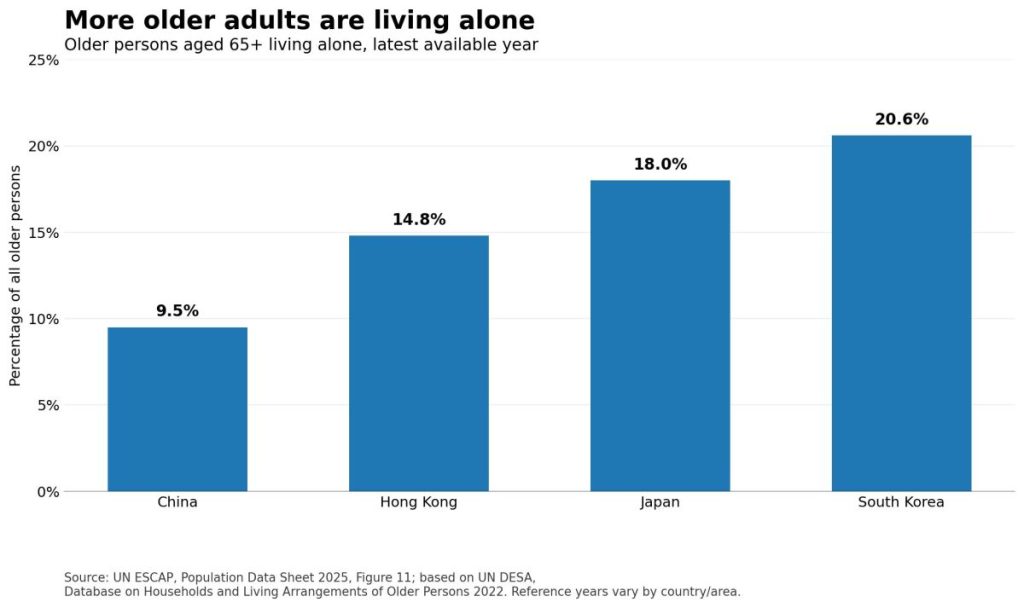
Japan offers perhaps the clearest example of where this can lead.
Single-person households already represented about 38% of all Japanese households in 2020. Official projections put that figure at approximately 44% by 2050.
Older people are an important part of that transformation. Living alone does not automatically mean being lonely, vulnerable or unsupported. An older person may live independently while seeing family several times a week, receiving home-care services and participating actively in the community. Conversely, someone can live with other people and still experience isolation.
But living alone changes something practical: there may be nobody else in the home to notice when normal daily behavior suddenly changes. That distinction becomes important as more societies encourage older adults to remain at home.
South Korea shows another side of the problem
In South Korea, 22.1% of people aged 65+ were living alone in 2024, according to official Korean statistics.
At the same time, the country faces a significant economic challenge among its older population. OECD data put South Korea’s relative income-poverty rate among people over 65 at approximately 40% — one of the highest rates in the OECD.
These two realities can overlap. Living independently can represent autonomy. But living alone with limited income can also mean fewer options for purchasing help, modifying a home, arranging private care or paying someone to check in regularly.
South Korea has responded by expanding formal long-term-care infrastructure.
By 2025, its long-term-care system included almost 30,000 registered care institutions, with home-based providers accounting for the large majority. That shift matters. It suggests that elder care is gradually becoming something shared between families, communities and formal services, rather than something families can always provide alone.
Hong Kong: most older adults still want to remain at home
A 2024 Hong Kong government survey provides a particularly useful glimpse into what older adults themselves want.
Among people aged 65 and over:
- 76.3% said they preferred ageing in place over the following two years.
- Only 2.6% preferred residential care, while the remainder had not decided.
- 14.1% had experienced feelings of loneliness during the week before they were interviewed.
- Yet only 3.6% had received community support or elderly-care services during the previous year.
There is an important distinction here. Most older people are not asking to be constantly supervised. Many are asking to continue living ordinary lives in familiar homes and neighborhoods.
The challenge is building enough support around them that independence remains workable.
The question is shifting from “family or professional care?” to “how do they work together?”
This may be one of the most important changes happening across ageing societies. Family care and professional care are often discussed as though one replaces the other. In reality, older people increasingly live within a network of care.
- A daughter might call every evening.
- A son might visit at weekends.
- A home-care worker might come three mornings a week.
- A community organization might provide meals or social activities.
- A doctor might monitor a chronic condition.
- Neighbors might notice whether the shutters opened that morning.
- And technology can fill some of the gaps between those moments.
This is especially relevant because professional home care is intermittent by nature. A care worker may spend one or two hours with someone. There are still another 22 hours in the day.
Technology is becoming part of the care infrastructure
East Asia is particularly interesting because governments are already experimenting with this gap.
ESCAP has documented digital-ageing initiatives in China, Japan and South Korea, including smart-home technologies, digital health tools, communication platforms, artificial intelligence and systems designed to help older people remain connected with families and services.
- China has actively promoted what it calls smart elder care, combining technologies such as the Internet of Things, big data and artificial intelligence with traditional care services.
- Japan has experimented extensively with care robots, sensors and digital systems partly because its care workforce is under increasing demographic pressure.
- South Korea has developed technology-enabled services addressing health, dementia, social connection and people living alone.
The objective is not simply technological efficiency. At its best, the technology solves a very human problem:
How can we help older people maintain a good quality of life while living independently, even when family or caregivers can’t always be nearby?
But technology creates a second divide
The people who could benefit most from digital support are not always the people most comfortable using it. ESCAP describes a continuing “grey digital divide.” Internet use among people aged 75 and over remains significantly lower than among younger generations even in highly connected countries such as Japan and South Korea.
That means successful ageing technology cannot simply be designed for younger users and handed to older people.
- It needs to require less interaction.
- Fewer passwords.
- Fewer complicated menus.
- Less configuration.
- And ideally, less need for the older person to remember to do something at all.
There is an important design principle hidden inside this: the best technology for independent ageing may be technology that demands very little attention from the person using it.
Singapore offers an interesting glimpse of what comes next
Singapore is not part of East Asia geographically, but its ageing trajectory makes it a useful comparison.
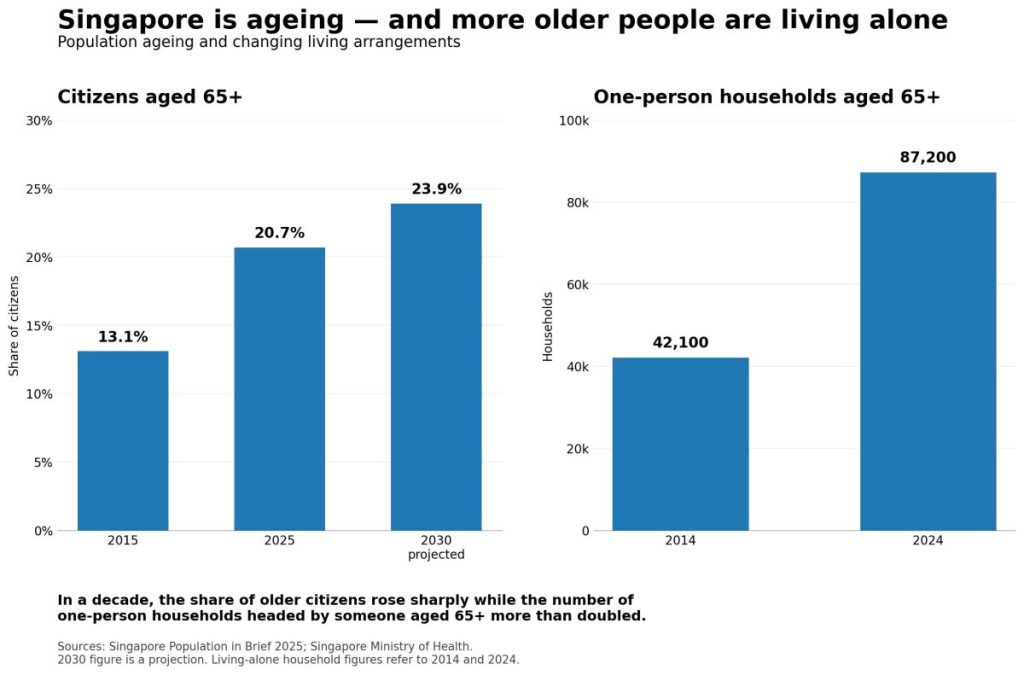
In 2025, 20.7% of Singapore citizens were aged 65 or older, up from 13.1% just ten years earlier. The number of citizens aged 80+ increased by roughly 60% between 2015 and 2025.
At the same time, living alone among older residents has become considerably more common. The number of one-person households headed by someone aged 65+ more than doubled from about 42,100 in 2014 to 87,200 in 2024.
Singapore’s response is particularly interesting because it does not treat residential institutions as the default answer. Its Age Well SG strategy explicitly aims to help older people remain within their homes and communities. The government is expanding Active Ageing Centers, community outreach and home-care services.
Its enhanced Home Personal Care program has even introduced 24/7 technology-enabled monitoring and response designed to detect falls and other incidents.
In 2024, around 87,000 Singapore residents aged 65+ were living alone. And among people aged 75+, about 40% were living either alone or only with other older people; roughly one quarter of that group needed help with at least one activity of daily living.
This is what ageing in place increasingly looks like:
- not complete independence,
- and not institutional care,
- but layers of support surrounding someone who still lives at home.
Independence and safety don’t have to be opposites
There is a temptation when discussing older people living alone to frame independence itself as the problem. It isn’t.
For many people, remaining at home means retaining routines, neighbors, possessions, privacy and control over everyday life.
The real question is what happens when something changes: a fall, an illness, confusion. A phone that suddenly isn’t being used. A normal morning routine that doesn’t happen. Traditionally, another person living in the household might notice. As households become smaller, that assumption becomes less reliable.
The challenge for families and care systems is therefore not necessarily to know everything an older person is doing. It is to recognize when something unusual might justify checking in.
That distinction matters, because there is a considerable difference between supporting someone’s independence and monitoring their life.
Smaller families may change what “family care” means
Perhaps the biggest change underway in East Asia isn’t that family care is disappearing. It is that family care is becoming distributed:
- Some of it remains with adult children.
- Some moves to professional carers.
- Some moves into community organizations.
- Some becomes part of public long-term-care systems.
- And some may increasingly be supported by technology.
That may actually allow families to concentrate more on the parts of care that technology and services cannot provide particularly well: conversation, companionship, judgement, reassurance, and simply being someone’s family.
The demographic mathematics make some change unavoidable.
- There will be more older people.
- There will be fewer younger relatives available per older person.
- And many of those older people will still want to live in their own homes.
The interesting question is no longer whether East Asian societies can preserve exactly the family-care model of previous generations. They probably cannot. The more useful question is:
What does caring for your parents look like when independence remains the goal, but family can no longer be physically present all the time?
Where Parents are OK fits
As families become smaller and more spread out, caring for an older parent doesn’t always mean being nearby. Sometimes it means finding simple ways to stay connected without making someone feel watched.
Parents are OK was built around that idea.
The app doesn’t use GPS, cameras or microphones. Instead, it looks for simple signs that everything is following its usual rhythm — such as normal phone activity and check-ins — and lets families know when something may need attention.
Families can choose their own inactivity limits and account for normal sleep or rest times, so the aim isn’t constant monitoring. It’s simply having another quiet signal between calls, visits and professional care.
- For an older parent who wants to keep living independently, that can mean a little more reassurance without giving up privacy.
- And for family members who can’t always be there, it can help answer a very ordinary question:
Is everything probably OK, or is this a good moment to check in?
And I?
While researching this article, I kept thinking about the arithmetic behind family care, from generation to generation.
When families had several children, responsibility could — at least in theory — be shared. Today, one adult child may be trying to look after two ageing parents while raising children of their own, working full-time and sometimes living hundreds or thousands of kilometers away.
That doesn’t necessarily mean we care less than previous generations did. It may simply mean that caring has to look different.
Maybe the goal isn’t to recreate a time when someone in the family was always nearby, but to build enough support around our parents — family, neighbors, community services, professional care and simple technology — that they can keep as much of their own life as possible.
I’m curious how you see it. As families become smaller and more spread out, how are the people around you caring for their aging parents?
Talk soon,
Ioana
Sources and research
- UN ESCAP — Population and Development in Asia and the Pacific: Population Data Sheet 2025
View source ↗ - UN ESCAP — Leveraging Digital Technologies to Improve Quality of Life for Older Persons: Case Studies from China, Japan and the Republic of Korea
View source ↗ - Statistics Bureau of Japan — Statistical Topics No. 146: Japan’s Older Population, 2025
View source ↗ - National Institute of Population and Social Security Research, Japan — Household Projections 2020–2050
View source ↗ - Statistics Korea — 2025 Statistics on the Aged
View source ↗ - National Health Insurance Service, South Korea — Long-Term Care Institution Statistics
View source ↗ - OECD — Pensions at a Glance 2025: Korea
View source ↗ - National Bureau of Statistics of China — Statistical Data for 2025
View source ↗ - Hong Kong Census and Statistics Department — Hong Kong Population Projections 2022–2046
View source ↗ - Hong Kong Census and Statistics Department — Thematic Household Survey: Health, Elderly Care and Social Inclusion
View source ↗ - Singapore Government — Population in Brief 2025
View source ↗ - Singapore Ministry of Health — Age Well SG
View source ↗ - Singapore Ministry of Health — Care Services for Seniors
View source ↗ - Singapore Ministry of Health — Meeting the Evolving Care and Living Needs of Seniors
View source ↗

My guiding question every day is: ”How can I make this better?” I have a creative mind, an eye for all things beautiful, and a drive to bring people together. With a background in non-formal education, psychology, entrepreneurship, and interior design, I believe there is always a new opportunity around the corner. Life is interesting. Enjoy and make the most of it!