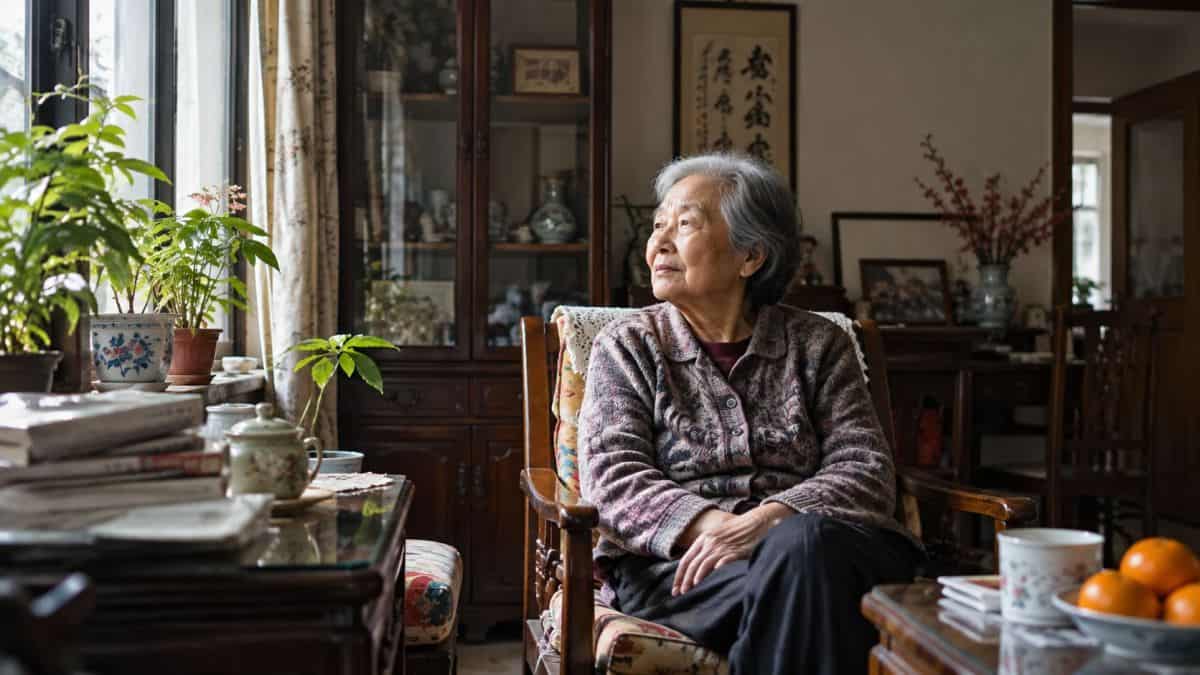
For most of human history, growing old usually meant growing old within a family. Parents lived with adult children. Several generations might share a home or live nearby. When someone needed help with meals, medication, shopping or simply getting through the day, that help was often expected to come from relatives.
That picture still exists in much of the world. But it is changing.
People are living longer. Families are becoming smaller. Adult children move away for work or education. Women, who have traditionally provided much of the unpaid care within families, are increasingly part of the paid workforce.
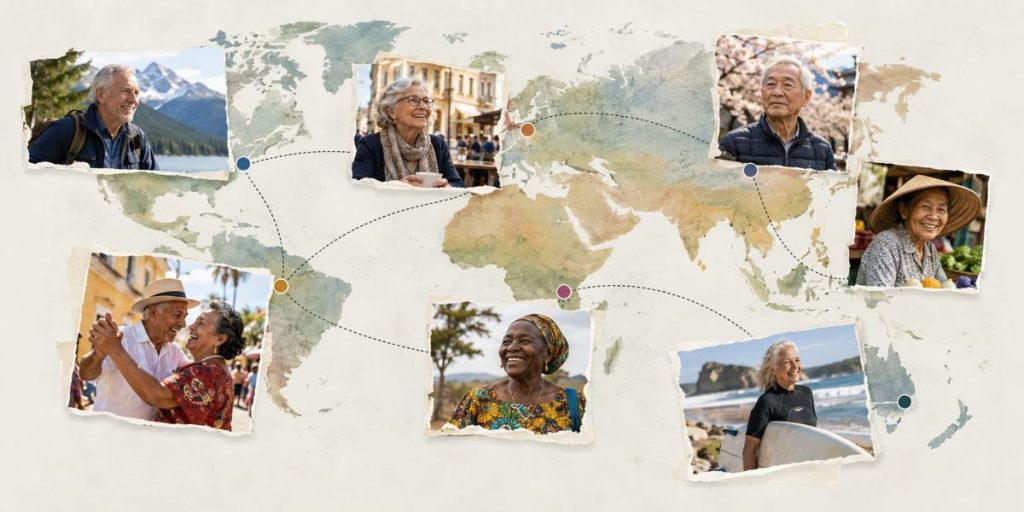
And more older adults are reaching their later years in households that look very different from those of previous generations. This doesn’t mean that everyone is growing old alone. It means that the distance between living independently and having someone nearby when you need them is becoming increasingly important.
The world is getting older
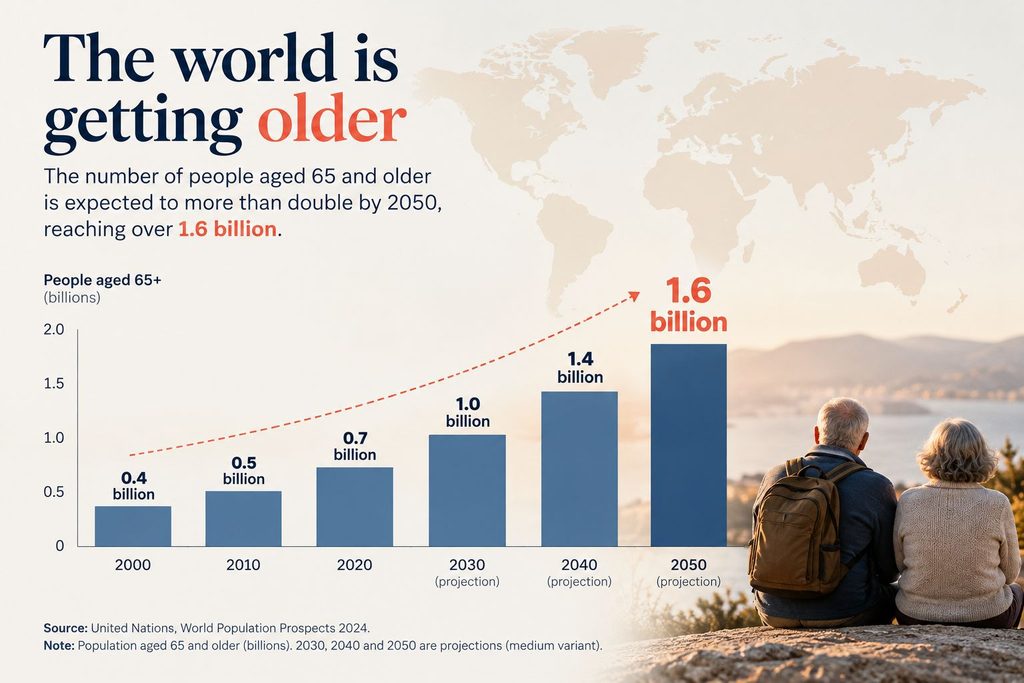
According to the United Nations, the number of people aged 65 and older is expected to exceed 1.6 billion by 2050. Population ageing is occurring in almost every country, although countries are reaching this point at very different speeds.
The transformation comes from something fundamentally positive: people are living longer.
But at the same time, fertility has fallen across much of the world. In more than half of countries and territories, women now have fewer than 2.1 children on average — the approximate level needed for a population to replace itself without migration.
Longer lives and smaller families gradually change the shape of society. There are more grandparents and great-grandparents. There are fewer children and grandchildren relative to them. And the family networks that once provided much of the support in old age are changing too.
Living alone is only part of the story
When we talk about “aging alone”, it is easy to picture an older person living by themselves.
Living alone does not necessarily mean being lonely, isolated or unsupported. Someone may live independently while having children nearby, seeing friends regularly and receiving help from neighbors or community services.
The opposite can also be true. An older person may technically live with relatives but spend much of the day alone because everyone else works. Another may live with family but have no one capable of providing the care they increasingly need. That distinction becomes important when we compare countries.
The United Nations’ global database on older people’s living arrangements draws on censuses and household surveys from around the world and shows enormous differences in how older people live. In some countries, living independently or with a spouse is common. Elsewhere, multigenerational households remain the norm.
And gender matters almost everywhere. Older women are generally about twice as likely as older men to live alone, largely because women tend to live longer and are therefore more likely to experience widowhood.
So perhaps the more useful question isn’t simply: Who lives alone?It is: Who is available when an older person needs help?
Where living alone is more common
Living alone in later life is particularly common in many higher-income countries.
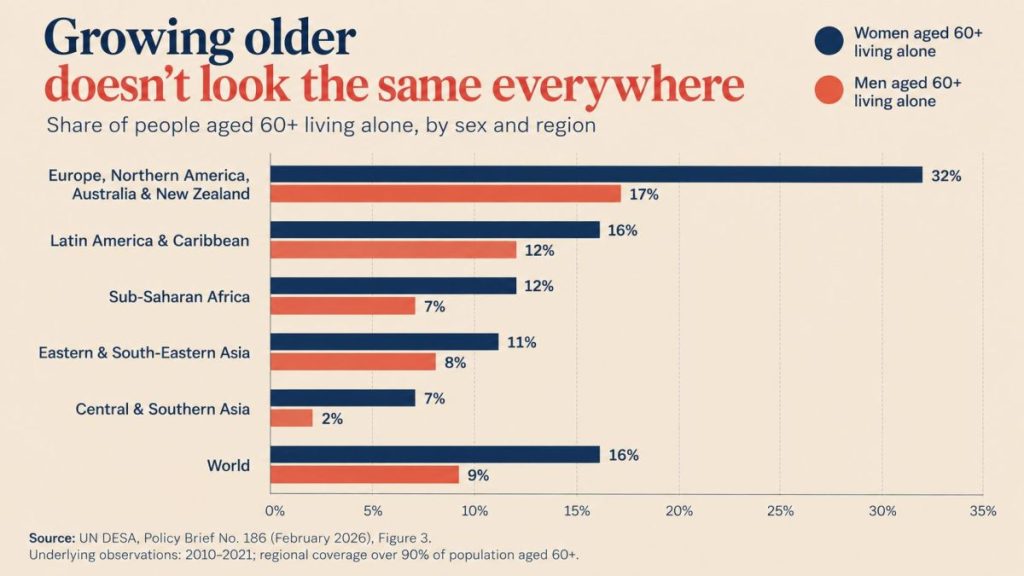
Europe and North America are among the regions where independent living among older adults has become well established. Australia shows a similar pattern: 25% of people aged 65+ living in private dwellings lived alone in 2016. Among those aged 85 and over, the figure was 35%.
In wealthier countries, pensions, accessible housing, public transport, home-care services, health systems and other forms of social protection can make it possible for an older person to maintain a separate household.
In other words, living alone can sometimes be a sign that independent ageing is possible. But independence also creates a different challenge. Family members may no longer see an older parent every day. They may live across town, across the country or in another country altogether.
The question becomes less about sharing a home and more about maintaining connection across distance.
In much of the world, generations still live together
The picture looks different across large parts of Africa, Asia and Latin America. Multigenerational households remain much more common, and family members continue to provide a large share of everyday support for older relatives.
That arrangement can offer enormous advantages. Someone is often nearby. Meals, transport and household tasks can be shared. Grandparents may care for grandchildren while adult children support their parents.
But living together does not eliminate the pressures created by population ageing. Families themselves are changing. Urbanization draws younger adults toward cities. International migration takes others much farther away. Fertility decline means fewer adult children may eventually share responsibility for ageing parents.
And the availability of family care cannot automatically be assumed simply because a culture has traditionally expected it.
Latin America: family care under increasing pressure
Latin America and the Caribbean provide one of the clearest examples of how quickly this balance can change. The region is ageing rapidly, but much of its long-term care still depends on families.
The Inter-American Development Bank estimates that about 8 million older people in the region had care needs in 2020. That number is projected to reach approximately 23 million by 2050. Historically, much of this care has been unpaid and provided within families, particularly by women.
But the demographic arithmetic is changing. A major 2026 IDB analysis estimates that 161 million people across Latin America and the Caribbean provide some form of unpaid care to children, older people or people with disabilities. Women represent 62% of those caregivers and provide 76% of all unpaid care hours.
Today, most of those hours still go toward children. As populations age, that balance is expected to shift.
If current arrangements continue, the IDB estimates that by 2050 the region could have 27 million additional unpaid caregivers for older people, even while the number caring for children declines. It is a striking illustration of a transition many countries are only beginning to confront: families may remain central to elder care, while becoming less able to provide it in the way previous generations did.
Africa: strong family networks, but a rapidly changing future
Sub-Saharan Africa remains much younger than Europe or East Asia. But that can obscure what is coming. The World Health Organization estimated that the number of older people in sub-Saharan Africa would more than triple, from approximately 46 million in 2017 to 165 million in 2050.
Today, families provide the majority of long-term support for older adults in the region. Formal long-term-care systems remain limited in many countries. That model has deep cultural and social roots, but it is also being affected by migration, urbanization, changing employment patterns and smaller households.
The interesting question for Africa may therefore be less about whether older people suddenly begin living alone in large numbers and more about whether traditional family-support systems can adapt as the number of older people increases.
WHO has argued that developing formal care systems does not have to mean replacing family care. Organized services can complement family involvement while allowing older adults to remain connected to their communities.
That distinction matters. The future of elder care does not have to be family or professional care. Increasingly, it may be both.
South and Southeast Asia: ageing before care systems are fully developed
Asia contains more older people than any other part of the world. Across Asia and the Pacific, there were around 516 million people aged 65+ in 2025, representing 10.8% of the population. By 2050, that share is projected to reach 19.4%.
But those regional numbers hide enormous differences. Japan, South Korea and China are already dealing with advanced population ageing. Countries such as Bangladesh, Cambodia, Malaysia, the Philippines, Sri Lanka and Thailand are at different points in the same demographic transition. Many are ageing much faster than today’s older European societies did historically.
At the same time, traditional family structures are changing. The UN Economic and Social Commission for Asia and the Pacific has warned that evolving family structures and living arrangements may no longer provide the level of support older family members once received.
This creates a difficult timing problem. Some countries are growing old before comprehensive long-term-care systems have had time to develop. Families remain essential, but governments are increasingly looking at home care, community services, social protection and formal long-term care to fill the gaps.
The transformation already visible in East Asia may therefore offer a glimpse of questions that many other Asian countries will face over the next few decades.
Australia and New Zealand: independence supported by formal care
Australia and New Zealand sit at another point on the spectrum. Population ageing is already well established, independent living is common, and governments have developed formal systems intended to support older people both at home and in residential care.
Australia provides a useful example of how household structures may continue changing. The Australian Bureau of Statistics projects that the total number of people living alone could increase from 2.6 million in 2021 to between 3.4 and 4 million by 2046, with population ageing accounting for much of the increase.
Among older Australians, living alone becomes increasingly common with age, particularly among women. Yet the response is not necessarily to move everyone into residential institutions. Home support, community care, informal caregiving and residential care increasingly form different parts of a continuum.
That idea — supporting people where they live rather than assuming that ageing eventually requires leaving home — is appearing in ageing policy far beyond Australia.
Around the world, ageing in place is becoming the goal
Despite enormous cultural differences, one idea appears repeatedly in ageing policy: help people remain part of their homes and communities for as long as it works for them.
The World Health Organization describes ageing in place not simply as staying in exactly the same house forever, but as maintaining connections with community, friends and family while living somewhere appropriate to a person’s changing needs.
Sometimes that means remaining in the family home. Sometimes it means moving to a smaller or more accessible home nearby. And sometimes it requires home carers, meal services, transportation, health care, community centers or help from family members.
WHO increasingly describes home- and community-based long-term care as an important alternative to relying primarily on residential institutions. The underlying idea is simple: needing some support does not automatically mean losing independence.
But the people providing that support are changing too
There is another side to the story. For generations, much of elder care has been largely invisible.
- Someone cooked.
- Someone drove a parent to an appointment.
- Someone checked whether medication had been taken.
- Someone stopped by after work.
- Someone called every evening.
And that “someone” was very often a daughter, wife or other female relative. That model becomes harder to sustain when families have fewer children, relatives live farther apart and the people traditionally expected to provide unpaid care also have jobs, children and other responsibilities.
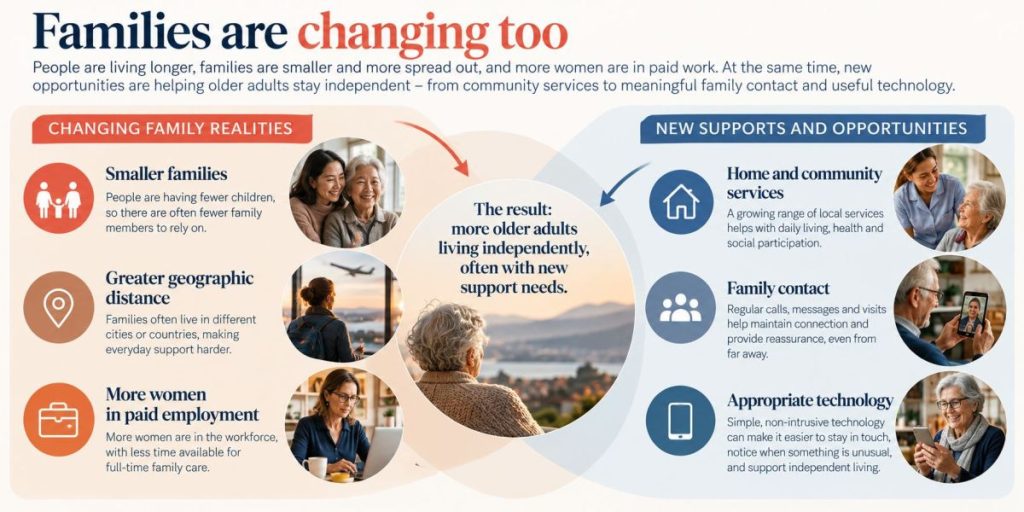
This does not mean families are becoming less caring. It means care has to operate under different conditions.
- A son living 300 kilometers away may care deeply about his father.
- A daughter working full-time may still want her mother to remain independent.
- Siblings living in different countries may all want to help.
What they no longer necessarily have is physical proximity.
Technology is becoming part of the space between independence and care
That is one reason technology increasingly appears in conversations about ageing. Not as a replacement for people. And not necessarily as continuous monitoring.
Sometimes technology simply helps fill the gaps between human contact. A video call makes distance smaller. A medication reminder supports routine. An emergency button provides a way to ask for help. A phone can provide clues that someone’s normal day has changed.
Digital tools are also increasingly being incorporated into community-based ageing programs. In Asia, for example, WHO notes that countries developing integrated community-care models are increasingly using digital tools alongside health and social services.
The useful question is therefore not: How can technology watch older people?It is: How can technology help older people remain independent while giving families enough information to know when they may need to step in?
The future probably isn’t living alone or living with family
Looking across countries, there is no single model for ageing.
- In some societies, living alone is common. In others, three generations still share a home.
- Some countries have extensive public long-term-care systems. Others rely almost entirely on relatives.
And many sit somewhere between those extremes. But the direction of change is surprisingly consistent. People are living longer. Families are getting smaller. Adult children are increasingly mobile. Traditional caregiving roles are changing. And the number of people reaching very old age is growing.
By the late 2050s, the United Nations projects that more than half of all deaths worldwide will occur at age 80 or older, compared with just 17% in 1995. That is an extraordinary achievement.
It also means families and societies are learning how to support a stage of life that far more people now get to experience. Perhaps the future of ageing won’t be defined by whether someone lives alone or with their children.
It may be defined by whether people can remain independent without becoming disconnected from the people who care about them.
And now…
After looking at the numbers from America, Europe, East Asia and now the rest of the world, I keep coming back to something surprisingly simple: I don’t think most families want to know everything their ageing parents are doing.
We want them to have their own lives. Their routines. Their homes. Their privacy. Their independence.
But we also want to know when something is different. Not because getting older should mean being watched. Because sometimes caring for someone means giving them space — while still being close enough to notice when they might need you.
Maybe that balance will look different in every family and every culture. But as families become smaller and more spread out, I suspect more of us will have to find it.
It’s also one of the reasons we created Parents are OK. We wanted to find a way for families to have a little more reassurance without asking older parents to give up their privacy or independence. Not to replace conversations, visits or care, but to offer another small way of staying connected.
What does staying connected without taking away independence look like in your family?
Talk soon,
Ioana

My guiding question every day is: ”How can I make this better?” I have a creative mind, an eye for all things beautiful, and a drive to bring people together. With a background in non-formal education, psychology, entrepreneurship, and interior design, I believe there is always a new opportunity around the corner. Life is interesting. Enjoy and make the most of it!