Your mother usually checks her phone first thing in the morning. It is 10:30 and she hasn’t.
You send a message. No answer.
Nothing has happened, as far as you know. There is no emergency alert, nobody has called. She may simply be sleeping late, gardening, taking a shower or enjoying a morning without looking at her phone. And yet a small question starts running in the background:
Is everything okay?
For a growing number of American families, this is part of what caring for an aging parent looks like.
It isn’t necessarily hands-on caregiving. It isn’t necessarily a medical emergency. Often, it is simply trying to support someone who wants to continue living independently while accepting that you cannot always be there to see whether their day is unfolding normally.
The numbers suggest that this situation will become increasingly common.
America is getting older. Millions of older adults live alone. Most want to remain in their own homes. At the same time, tens of millions of relatives are already providing some form of unpaid care, frequently while working, raising children and managing households of their own.
And increasingly, both generations carry a smartphone.
Put those trends together and an interesting question appears: How can families stay aware without turning independence into surveillance? Here is what the recent research tells us.
1. America is getting older — quickly
The scale of the demographic change is easy to underestimate.
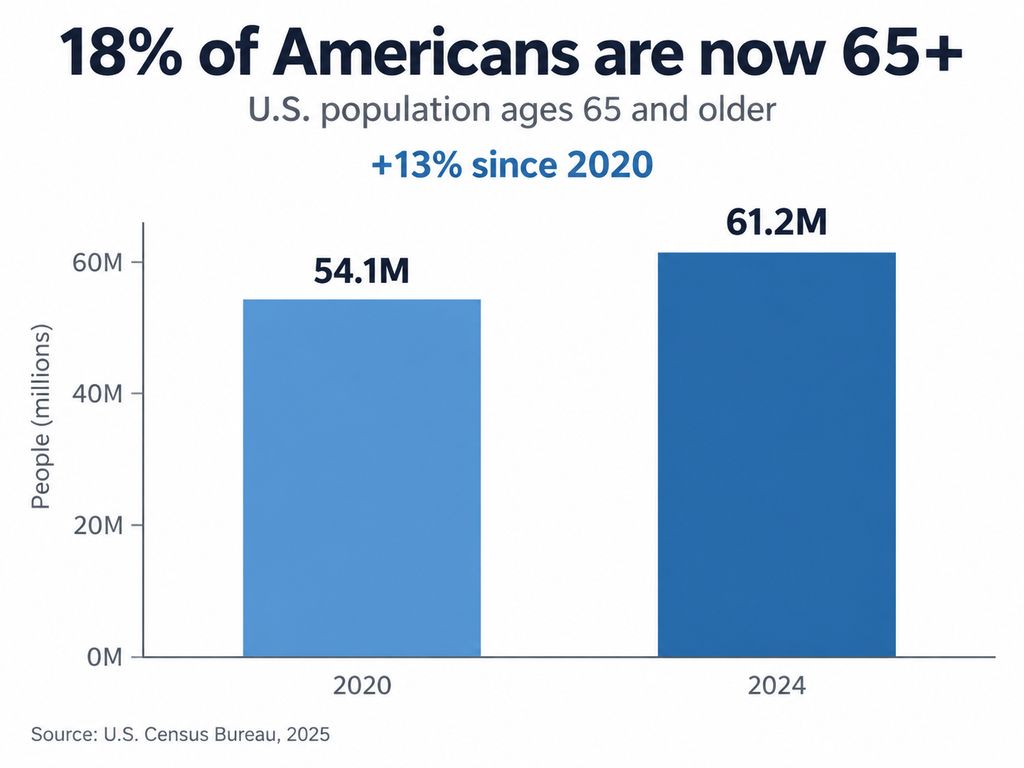
According to the U.S. Census Bureau, the number of Americans aged 65 and older reached 61.2 million in 2024, representing 18% of the U.S. population.
That population grew by 13% between 2020 and 2024, far faster than the 1.4% increase among working-age adults during the same period. In just one year, from 2023 to 2024, the 65+ population grew another 3.1%.
The Census Bureau has projected that around one in five Americans will be 65 or older by 2030, when all members of the baby-boom generation will have passed 65.
This isn’t a short-lived baby-boomer bump. It is a structural change in what an American family looks like. But population size is only the beginning of the story. The more interesting question for families is: Where are those older Americans living, and with whom?
2. Millions of older Americans are living alone
According to the 2024 American Community Survey, approximately 15.8 million Americans aged 65 and older lived alone.That is roughly one in four people in this age group.
That number deserves a little care in how we interpret it. Living alone does not mean being lonely. It does not mean being frail. And it certainly does not mean that someone is incapable of looking after themselves.
For many older adults, living alone is exactly what independence looks like. They have their home, habits, friends, neighbors, pets, routines and familiar places. Their children may live nearby, across the state or on the other side of the country. They may speak every day or twice a week.
The practical difference is simply that there may be nobody else in the house who naturally notices when the routine changes. If someone who normally gets up at 7:00 is still in bed at noon, there may be no one there to see it. If they leave their phone untouched all day, nobody necessarily knows.
If they aren’t feeling well and decide to sleep for several hours, that may be perfectly fine — but from somewhere else, their son or daughter has very little information with which to distinguish an ordinary quiet day from an unusual one.
That is the information gap created by independent living.
It is worth separating this from another issue that is often mixed into the same conversation: social isolation. The CDC identifies older adults and people living alone among groups at greater risk of social isolation, and reports associations between lack of social connection and several physical and mental health problems. But living alone and being socially isolated are not the same thing. Someone can live alone and have a rich social life; someone can live with others and still be isolated.
The challenge we are talking about here is narrower: When someone lives independently, how does their family know when there is actually a reason to check in?
3. Most older Americans want to stay exactly where they are
One possible answer would be to have older people move in with their children, enter senior communities or transition into assisted living earlier. But that is not what most Americans say they want.
AARP’s 2024 Home and Community Preferences Survey found that 75% of Americans aged 50 and older want to remain in their current home for as long as possible, while 73% want to remain in their current community. The preference is even stronger among adults over 65.
Even when care becomes necessary, home remains the preferred setting. Among adults 50+, AARP found that 61% would prefer to receive long-term care at home using a combination of family and paid help. Far fewer expressed a preference for assisted living or nursing-home care.
This matters because sometimes we talk about aging at home as if it were simply a cheaper alternative to institutional care.
For many people, it is much more personal than that. It means waking up in your own bedroom. Knowing which cupboard contains the coffee. Walking the dog on the same street you have walked for years. Having the neighbor who knows your name. Keeping the garden you planted. Deciding what you eat, when you sleep and what you do with your afternoon without somebody else’s schedule determining your day. Independence is not just a logistical arrangement. It is part of a person’s identity. The challenge, then, is not to eliminate independence in order to create safety.
It is to find ways of supporting safety without unnecessarily taking independence away.
4. Families are already doing an enormous amount of the caring
Behind independent aging sits another system — one that doesn’t always look like a system at all: Family.
The 2025 Caregiving in the US research from AARP and the National Alliance for Caregiving estimated that 63 million American adults were providing ongoing care to an adult or child with a complex medical condition or disability — close to one in four adults.
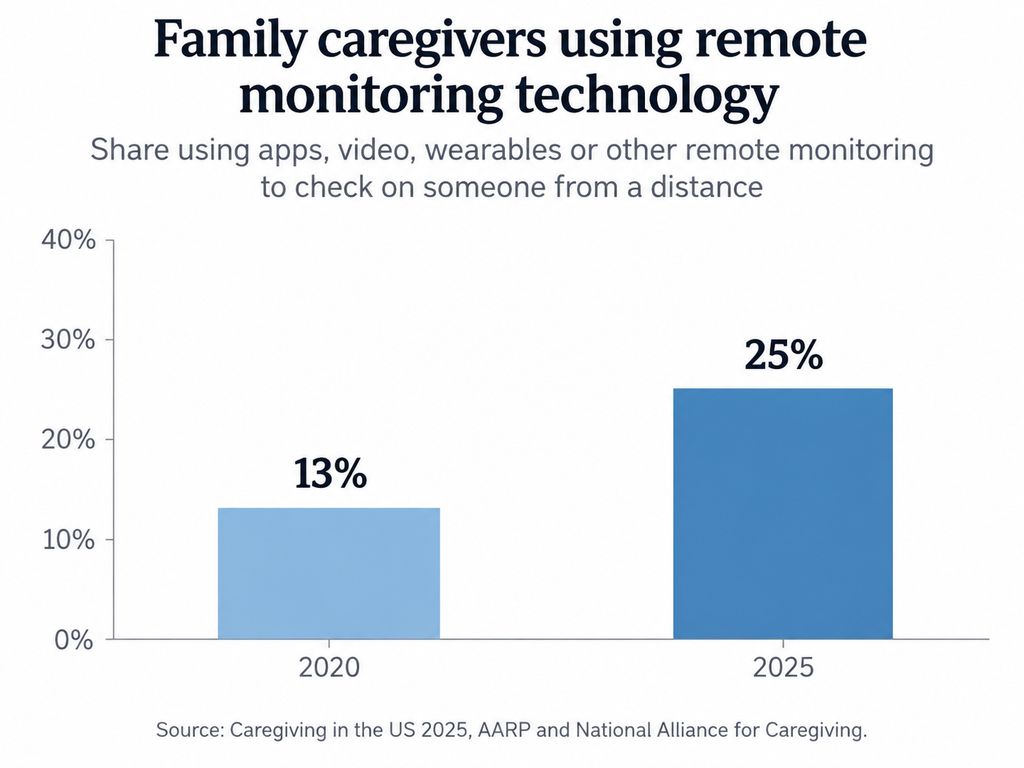
In 2025,
25% of family caregivers used an app, video, wearable device
or another form of remote monitoring
to check on their care recipient — up from 13% in 2020.
A 2026 companion report looking specifically at care for people aged 50 and older found that more than 51 million Americans — nearly one in five adults — were providing care to someone in this age group.
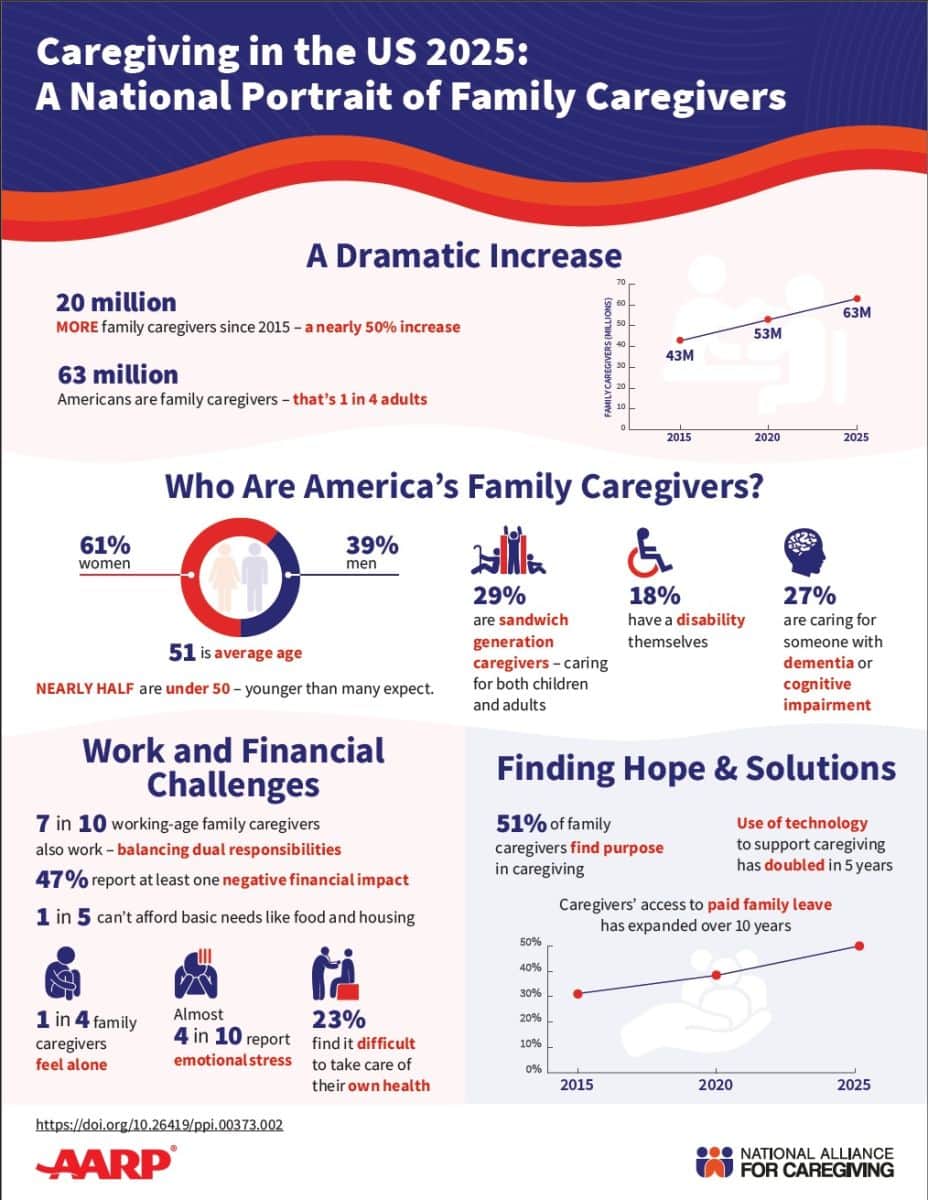
The 2025 edition of Caregiving in the US, released by AARP and the National Alliance for Caregiving
And this is not necessarily an occasional drive to a doctor’s appointment. Among caregivers supporting someone 50 or older, AARP reports an average of:
- five years spent in the caregiving role and 26 hours of care per week.
- forty-four percent were classified as providing high-intensity care, up from 39% in 2020.
Then there is the generation caught in the middle. A September 2026 AARP/National Alliance for Caregiving report estimates that nearly 17 million Americans are simultaneously raising children and caring for another adult.
These so-called sandwich-generation caregivers have an average age of 42. Around 67% reported some form of disruption to their work because of caregiving. It isn’t hard to picture the person behind those statistics.
- Someone is answering a work email while arranging their father’s cardiology appointment.
- Someone is picking a teenager up from soccer while remembering that their mother needs a prescription renewed.
- Someone is making dinner and wondering whether to call dad again because he didn’t answer the first time.
AARP’s reporting contains plenty of real examples. Jessica Guthrie became a caregiver in her twenties after her mother developed early-onset Alzheimer’s. At first she was caring from a distance, travelling while trying to maintain a demanding career. She later described herself as effectively burning the candle at both ends. Her situation eventually involved far more care than most independent older adults require. But the tension is recognizable much earlier in the process:
How much should I check? How much should I intervene? When should I worry? Families often begin asking those questions long before anyone would describe themselves as a “caregiver.”
5. Distance changes what caring looks like
Most family caregivers do live reasonably close to the person they support. But not all.
The latest AARP data on caregivers of adults aged 50+ found that 74% live with their care recipient or within 20 minutes of them. Turn that statistic around and roughly one in four does not.
In a country the size of the United States, “not nearby” can mean many things.
- It might mean an hour’s drive.
- It might mean another state.
- It might mean Los Angeles and Boston.
Actor Michael Chiklis, for example, has described being his mother’s health care proxy and overseeing her care while he was living in Los Angeles and she was in Boston.
Writer Cassandra Brooklyn has described another version of long-distance caregiving: arranging her mother’s appointments around visits, handling bills online and serving as the main contact for her mother’s Medicaid case manager even when she was away.
These stories illustrate something important: caregiving from a distance doesn’t necessarily mean providing less care. It often means providing different care.
- You coordinate.
- You call.
- You arrange.
- You remind.
- You watch for clues.
And because you cannot casually drop by the kitchen or notice that the curtains haven’t opened, communication starts carrying more information than it was originally designed to carry.
- “Mom didn’t answer” becomes data.
- “Dad hasn’t been online today” becomes data.
- “She usually calls after breakfast” becomes data.
- “He usually walks more than 1000 steps every day, in the morning.” becomes data.
Much of the anxiety comes from not knowing whether anything is wrong.
6. The smartphone has quietly become part of aging at home
There is another major change happening alongside America’s demographic shift. Older adults are far more digitally connected than stereotypes about aging often suggest.
AARP’s latest technology research found that smartphone ownership among Americans aged 50+ increased from 55% in 2016 to around 90% in 2025.
Texting is now their most commonly used communication method, and half of caregivers surveyed said they use technology to help organize caregiving responsibilities. That changes the possibilities considerably.
A decade or two ago, technology designed to support independent aging often meant installing specialist hardware: emergency buttons, cameras, sensors or dedicated monitoring systems. Today, many older adults already carry a sophisticated connected device everywhere they go: their phone.
They use it to message their children, check the weather, navigate, read the news, take photographs, pay bills and make appointments. That means a safety tool does not necessarily need to introduce another device into someone’s life. Sometimes it can work with the device already sitting on the kitchen table.
But there is an important warning in the same AARP research. Around three in five adults 50+ say technology is not designed with people their age in mind, and privacy remains one of the biggest barriers to adopting new technology.
So the question is not simply: Can technology monitor more?
It is: How little monitoring can provide useful reassurance?
That is a very different design problem.
7. Older adults want safety — but they also care about privacy and control
This may be the most important part of the entire conversation. When families become worried about an older relative, it is easy to design solutions entirely around the needs of the worried person. More information feels safer.
- A camera gives more information than a motion sensor.
- GPS gives more information than a simple activity signal.
- Continuous monitoring gives more information than an occasional check-in.
But the person being monitored is still an adult. An independent adult. And research suggests that older adults notice this trade-off very clearly. A 2024 review published in JMIR mHealth and uHealth examined 15 studies of adults aged 50+ using or considering smart-home technologies such as motion sensors, smart speakers and home-monitoring systems.
Thirteen of the 15 studies raised privacy concerns, including concerns about who could access collected data and how it might be used. At the same time, nine of the 15 studies reported enthusiasm about potential safety benefits.
The two ideas coexist. Older people are not necessarily rejecting technology. They are asking what it sees. What it hears. What it records. Who receives the information. And whether they remain in control.
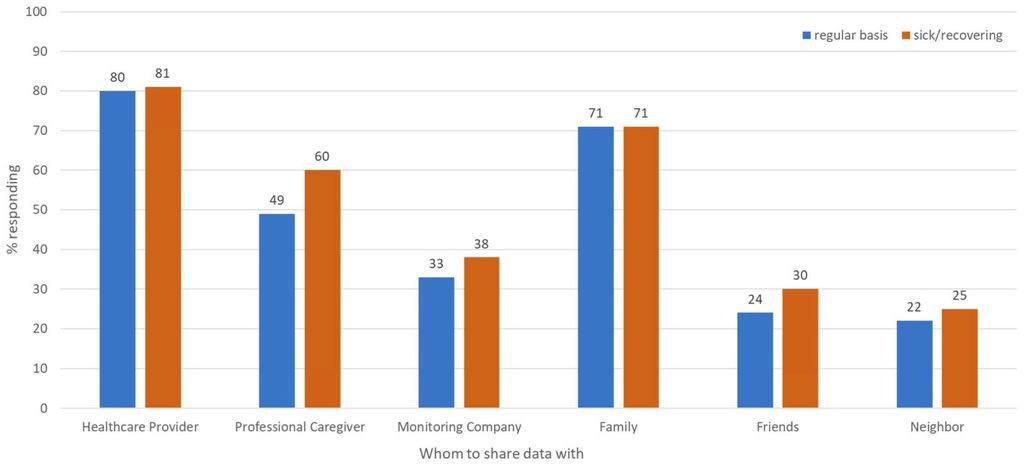
Older adults were most comfortable sharing home-monitoring information with healthcare providers and family members.
Source: Schoenfeld ER et al. Engaging Older Adults to Guide the Development of Passive Home Health Monitoring to Support Aging in Place. Sensors. 2025;25(24):7413. Licensed under CC BY 4.0.
The review also found that less intrusive technologies such as environmental or motion sensors tended to be more acceptable than cameras or other more obviously surveillance-oriented technologies.
A more recent U.S. study reached a similarly nuanced conclusion. Researchers working with 112 adults aged 60+ found greater willingness to use passive home-monitoring technology when people imagined being home alone, ill or recovering from illness. Participants were particularly willing to share information with family members and health-care providers.
But discussions also raised concerns about privacy, security, loss of independence and control over data. Because this was a relatively small study rather than a nationally representative survey, its percentages should not be generalized to every older American. The themes, however, closely resemble those found in the broader research literature.
This is an important distinction. Older adults do not have to choose between: complete privacy and complete monitoring. There is a large space between those extremes. And that may be where some of the most useful technology belongs.
The real problem may be uncertainty
Taken individually, none of these statistics proves that a particular app, device or monitoring system will make an older adult safer. That would require different evidence.
What the data does show is that several powerful trends are converging:
- America has 61 million+ people over 65.
- Millions live alone.
- Most older adults want to remain in their own homes.
- Family members already provide enormous amounts of unpaid care.
- Some live far enough away that casually checking in is impossible.
- And smartphones are now part of everyday life for the overwhelming majority of Americans over 50.
The result is a relatively new family problem. We want our parents to remain independent. They want the same thing. But independence also means that we don’t always know what is happening. And most days, we don’t need to.
- Nobody needs an alert because Mom spent three hours reading instead of answering her phone.
- Nobody needs GPS coordinates because Dad went for coffee.
- Nobody needs to watch Grandma through a camera to know that she is living her normal life.
What families often need is something much smaller: a way to notice when normal suddenly becomes unusual.
That is the space in which tools like Parents are OK are intended to operate.
Not as a replacement for family contact. Not as medical monitoring. Not as an emergency response service. And not as a way to watch an older parent throughout the day.
The idea is simpler: use a small amount of information — such as whether a person’s phone has shown normal activity within a time period their family defines — to help decide when a human check-in might actually be worthwhile. Because ultimately, good technology for independent aging should not make an older person feel watched.
It should make it easier for everyone to get on with their day, when everything is normal. And easier to notice when perhaps it isn’t.
And me?
I keep coming back to the same question: how do we care for our parents without slowly taking away the independence we are trying to protect?
For me, the answer isn’t knowing everything. It’s having enough information to know when something feels different — and when it might be worth picking up the phone.
I’m curious how this works in your family. What makes you decide, “I should check in”?
Talk soon,
Ioana
Research referenced
This article draws on recent U.S. demographic, caregiving, technology and aging-in-place research from the U.S. Census Bureau, AARP, the National Alliance for Caregiving and the Centers for Disease Control and Prevention, together with peer-reviewed research published in JMIR mHealth and uHealth and Sensors.
- U.S. Census Bureau — Older Adults Outnumber Children in 11 States and Nearly Half of U.S. Counties
View source - U.S. Census Bureau — 2024 American Community Survey: Living Arrangements of Adults 18 Years and Over by Age
View source - U.S. Census Bureau — Demographic Turning Points for the United States: Population Projections for 2020 to 2060
View source - AARP — 2024 Home and Community Preferences Survey
View source - AARP & National Alliance for Caregiving — Caregiving in the US 2025
View source - AARP & National Alliance for Caregiving — Family Caregivers of Adults Age 50+: Caregiving in the US 2025
View source - AARP & National Alliance for Caregiving — Sandwich Generation Caregivers
View source - AARP — 2026 Tech Trends and Adults 50-Plus
View source - CDC — Social Connectedness: Risk and Protective Factors
View source - JMIR mHealth and uHealth — User Perception of Smart Home Surveillance Among Adults Aged 50 Years and Older: Scoping Review (2024)
View source - Sensors — Engaging Older Adults to Guide the Development of Passive Home Health Monitoring to Support Aging in Place (2025)
View source - AARP — Jessica Guthrie: Caregiving in the US 2025
View source - AARP — Michael Chiklis on Long-Distance Caregiving
View source - AARP — Help for Long-Distance Caregivers
View source
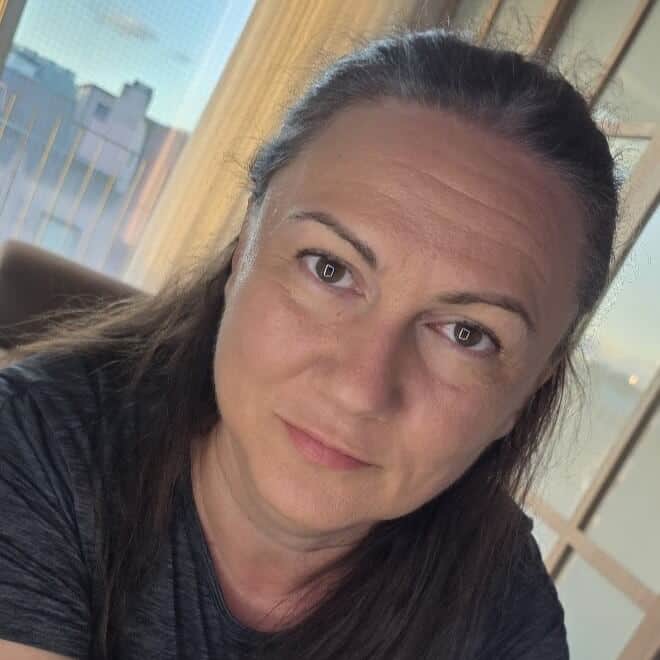
My guiding question every day is: ”How can I make this better?” I have a creative mind, an eye for all things beautiful, and a drive to bring people together. With a background in non-formal education, psychology, entrepreneurship, and interior design, I believe there is always a new opportunity around the corner. Life is interesting. Enjoy and make the most of it!