A Practical Safety Guide for Families With Elderly Parents
- Unsafe use of household equipment
- Environmental risks
- Hygiene and self-care decline
- Home access and emergency access
There are so many facets to caring for someone vulnerable. Just basic, normal, day-to-day living is more complex than we would say off the top of our heads. It’s not only health and accidents we need to think about when taking care of our elderly parents and family members.
Unsafe Use of Household Equipment
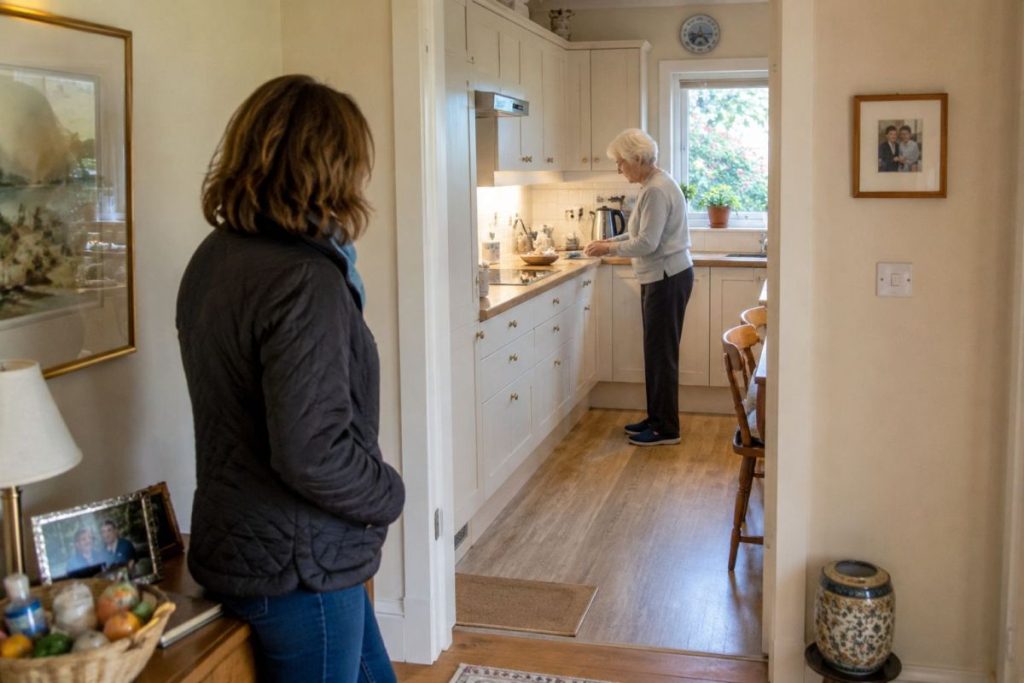
You cannot just start to babyproof the home and call it safe. Your parents want to be able to do the things they always did and live their lives as they are used to. So locking the fridge door and making the stove disappear under a cover is not really an option.
My mother gave up using the appliances she started to find too difficult to use, like the oven and the kitchen robot. She started to rely more on the stove and the microwave for cooking and heating up food. I was the one to renovate and equip her home, so I could think about every detail:
- Take care of the electrical plan, have enough separate outlets for appliances, and not leave the option to overload sockets.
- Install an induction plate instead of a gas and flame one, because the hot surface turns off and cools down when not in use. This also removed the danger of a gas leak.
- And, even if potentially annoying, taps that turn off on their own could be an option if water is often forgotten running.
A bit dangerous was when she started to light candles on the bookshelves, inside the furniture, and I found burnt portions of wood above the flame. This is a judgment call: whether to move them to a safer place, go for electric candles, or just remove them from the home.
And my dad, well, he was always a DIY kind of guy, so he was always surrounded by power tools, nails, and chemicals. We slowly needed to make those less available and keep handy only simpler, smaller, easier-to-use tools for small projects. With him, improvised repairs to broken appliances could be a hazard we needed to keep track of. The risks of creative minds and active hands.
We just need to keep in mind: with narrowing awareness, focus, and reaction time, these small details of daily living can become unforeseen dangers.
Environmental Risks
The quality of living depends a lot on the way the space is organized and maintained, and on environmental factors. If it becomes harder for them to care for their homes, your elderly parents might not even notice or tell you that they struggle with temperature or humidity control, poor ventilation, or mold.
What I tried to do, when optimizing the home, was:
- Have the place easy to warm up, with the use of a boiler and radiators, because it was a familiar system for my parents, and they would not need to improvise something unsafe.
- Be careful to remove broken appliances and replace them, if needed, with the same model or similar ones that were easy to use.
- Install a remote control system to be able to open and close high windows without using a stool or a folding step ladder.
- Regularly check, communicate with neighbors, and solve any building problems, like infiltrations or mold.
Also part of their environment is how furniture is placed, how easy the circulation flow is from room to room, and how cluttered the floors and surfaces are. As years went by, I started to simplify the spaces, to store away furniture, decor, and clutter that faded into the background and were not used anymore. With small steps, some resistance, and the assurance that they still had their things, could still find them, and had them within reach, they appreciated an easier-to-navigate environment.
Hygiene and Self-Care Decline
As adults, we often think about developing and maintaining good habits. For us, for our children, for our communities. But there’s also the challenge of keeping a lifelong habit when things become difficult, when normal activities require more and more effort.
For elderly parents, simple actions they always did on autopilot can become a struggle, and then, day after day, the habit goes away. It might be hard for us to understand why all of a sudden they might not be bathing, changing their clothes, or seeing or caring for small wounds. But this was a long process: slow, quiet, subtle. We just see the end result.
For my parents, to take care of declining routines:
- I installed safety features in the bathroom, to make it easier for them to grab and hold onto a rail or a handle, to use a shower stool, and to have towels easy to reach.
- I simplified the wardrobe, and took my parents shopping for comfortable clothes and shoes that were easy to put on, take off, and wear.
- And when it was needed, I hired help to take care of the laundry and cleaning the home, and to notice if they needed help with anything.
Home Access and Emergency Access
When it comes to leaving the home and coming back in, or receiving help, the logistics are important.
My mom was no longer able to turn the key in the lock. She knew the right key, she knew where and how to use it, but her hands were just not strong enough to turn the key in the lock. She had two different access points, and for a while she was only able to use one of them. But after a couple of years, she was also no longer able to lock and unlock the main door. She would have had to leave the home unlocked, or just give up on going outside.
What did I do?
- By the time she could no longer use the keys, I had already hired help. She had someone visiting daily, at first for socializing and going for a walk together, and slowly taking over cooking, cleaning, laundry, medication, and basic care.
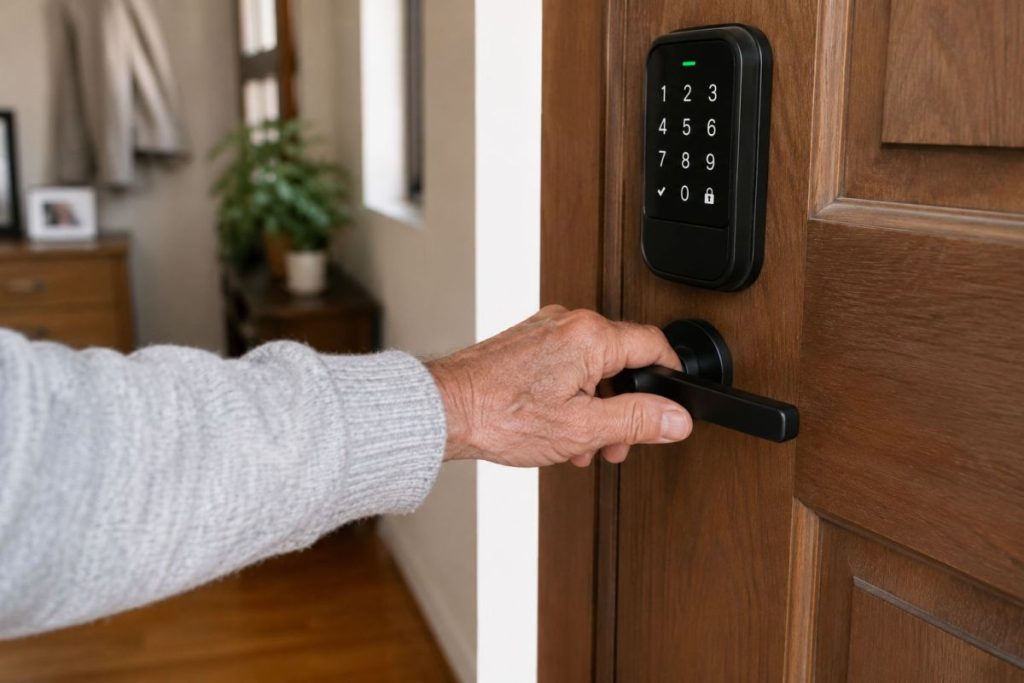
- We also found a lock that allowed for several different ways to lock and unlock the door. This way, we removed the need for a key, because the door could be unlocked with a code, a fingerprint, a physical key, phone proximity, or a command from an app. We also had a phone log of when and how the lock was used.
We also need to keep in mind that it’s not only about our elderly parents’ ability to exit and enter their own homes. It’s also about how easy it is for neighbors, helpers, or emergency teams to reach them when needed.
How Parents are OK Can Help
Because we are not present every moment of every day beside our aging parents, we need a way to get a signal that they are going about their day as usual, or that something might be different and needs our attention.
If you notice that your parent’s phone activity stops, you or the rest of the family can follow a clear intervention plan: call, contact a neighbor, request an in-person check from whoever can get there fastest, and make sure they have a way to get in. Parents are OK app is set to notify you after 24 hours of no phone activity, but that’s just a default setting. You can change the time as you need.
I feel like I just scratched the surface of home and daily living safety, so I am curious: what’s your family’s experience with this area? What other practical steps did you take to ensure their safety?
Take care. Talk soon,
Ioana

My guiding question every day is: ”How can I make this better?” I have a creative mind, an eye for all things beautiful, and a drive to bring people together. With a background in non-formal education, psychology, entrepreneurship, and interior design, I believe there is always a new opportunity around the corner. Life is interesting. Enjoy and make the most of it!